
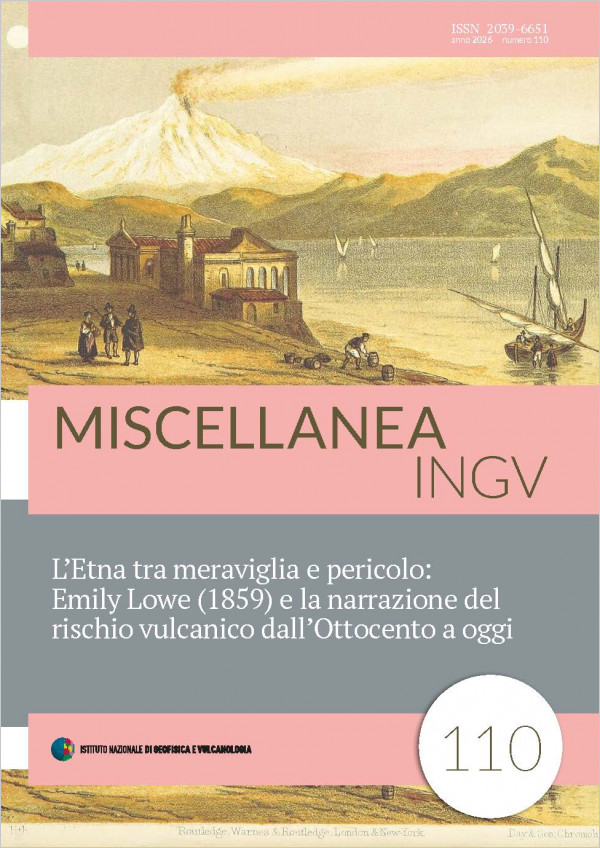
Etna between wonder and hazard: Emily Lowe (1859) and the volcanic risk narrative from the nineteenth century to the present day
Article Sidebar
Published:
2026-10-22
Keywords:
Storia della Vulcanologia, Comunicazione del rischio, Grand Tour, History of Volcanology, Risk communication
Main Article Content
Abstract
Between the 18th and 19th centuries, Mount Etna was one of the most visited destinations of the Grand Tour, attracting travelers and scholars from all over Europe. Travel diaries and memoirs form a narrative corpus of great interest, not only literary but also scientific, in which the perception of volcanic risk is elaborated and translated into accessible language. One of the first women to climb the volcano, if not the very first, was Emily Lowe, author of Unprotected Females in Sicily, Calabria, and on the Top of Mount Etna (1859), an account revealing a constant tension between real danger and irresistible fascination. This article aims to analyze Lowe’s text as an emblematic case of volcanic risk communication ante litteram, placing it within the broader framework of the narrative tradition on Etna and establishing a dialogue with contemporary models of volcanology and risk management. The continuities between past and present suggest how the collective image of Etna has been shaped over time through the public telling of eruptions, fear and wonder, and how the narrative layering built over time continues to shape the perception of risk in the populations living at the foot of the volcano today.
Article Details
Issue
How to Cite
Alabiso, C., Mattia, M., & Militello, P. (2026). Etna between wonder and hazard: Emily Lowe (1859) and the volcanic risk narrative from the nineteenth century to the present day. Miscellanea INGV, 110, 32 pp. https://doi.org/10.13127/misc/110