
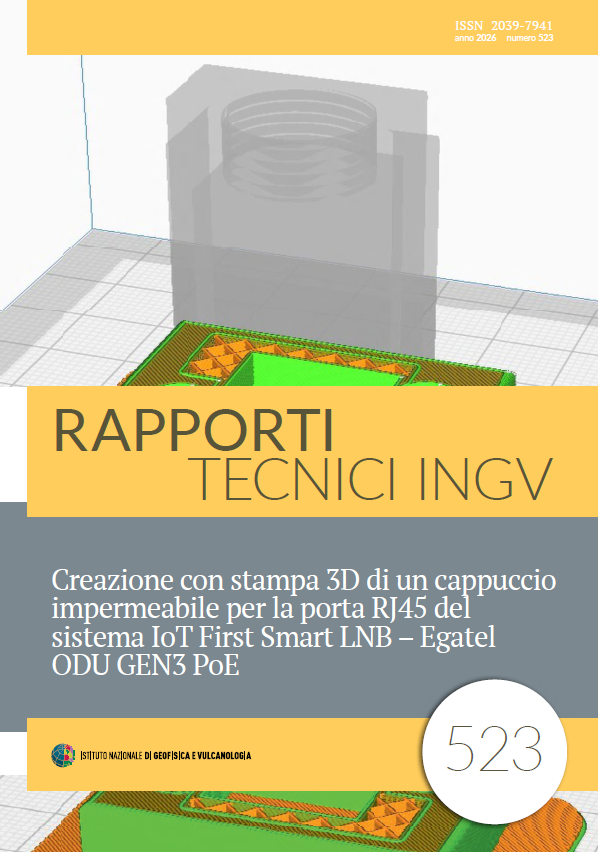
Creation via 3D printing of a waterproof housing for the RJ45 connection of IoT First Smart LNB – Egatel ODU GEN3 PoE
Article Sidebar
Published:
2026-08-28
Keywords:
Stampa 3D, LNB, CAD, 3D printing
Main Article Content
Abstract
To upgrade its data transmission devices, for multiparameter stations, the INGV National Earthquake Observatory (ONT) has decided to equip itself with new Ku-band satellite systems. Compared to the Ka-band system previously used, this system should ensure a more stable data flow with a stronger frequency band and immunity to atmospheric noises, such as to allow better reception of seismic and geodetic data sent by the stations. Furthermore, given the obsolescence and future decommissioning of the Ka-band data transmission mode, this new system would ensure technical support for future Over-The-Air updates to permit the long-term operability of the device consequently the continuity of the station’s data flow.
The main problem is that the LNB (Low Noise Block converter) or ODU (Outdoor Device Unit) a component of the new equipment, commercially called “IoT First” does not have a feature suitable for the purpose: the network cable entering the LNB, which allows data flow and power supply, is connected to a non-waterproof RJ45 port.
The dealer, “MBI Group s.r.l.”, from tests conducted at its headquarters in Pisa, has not encountered any problems. However, the INGV multiparameter stations, being in remote and difficult-to-access locations (countryside, mountains, marine environments) and exposed to atmospheric agents, could present complications for this equipment.
Therefore, the need to develop a zero-cost waterproof protective shell for the LNB connector, using 3D printing technology designed by CAD software.
Article Details
How to Cite
Terribili, A., Bucci, A., & Rao, S. (2026). Creation via 3D printing of a waterproof housing for the RJ45 connection of IoT First Smart LNB – Egatel ODU GEN3 PoE. Rapporti Tecnici INGV, 523, 28 pp. https://doi.org/10.13127/rpt/523